
What Are Meme Coins? A Plain-English Guide (2026)
What meme coins actually are, where they came from, how they trade, and why most of them go to zero. From Dogecoin to Pepe, BONK, and WIF.
Table of Contents
Key Takeaways
Meme coins are cryptocurrencies inspired by internet memes, jokes, or pop culture. Most attention and value come from community and social media rather than utility.
Meme coins are highly speculative. Prices can spike and crash quickly, so only risk what you can afford to lose.
Millions of meme coins exist, but very few last. Solana launchpads like Pump.fun have made it trivial to mint a token — the ratio of launches to survivors is brutal.
Meme coins are often categorized into themes including "dog coins" like Dogecoin, Shiba Inu and dogwifhat, "cat coins" like Popcat, MEW and Keyboard Cat, political and celebrity meme coins, and other viral trend tokens.
The majority of established meme coins exist on Ethereum and Solana. A growing number are launching on other chains such as Base and BNB Chain.
Introduction
A meme coin is what happens when an internet joke gets a ticker symbol. Dogecoin started in 2013 as a parody of altcoins and ended up with a multi-billion-dollar market cap. Pepe launched in 2023 and did roughly 7,000% in its first month. BONK was airdropped free to Solana users and became one of the largest tokens on the chain.
None of these have revenue. None have a product in the traditional sense. What they have is a community, a meme, and a token contract — and that turns out to be enough to move real money.
This guide covers what meme coins are, where they live (mostly Ethereum, Solana, Base, and BNB), how people buy and create them, and why most of them go to zero. Read it before you put money in, not after.
What is a Meme Coin?
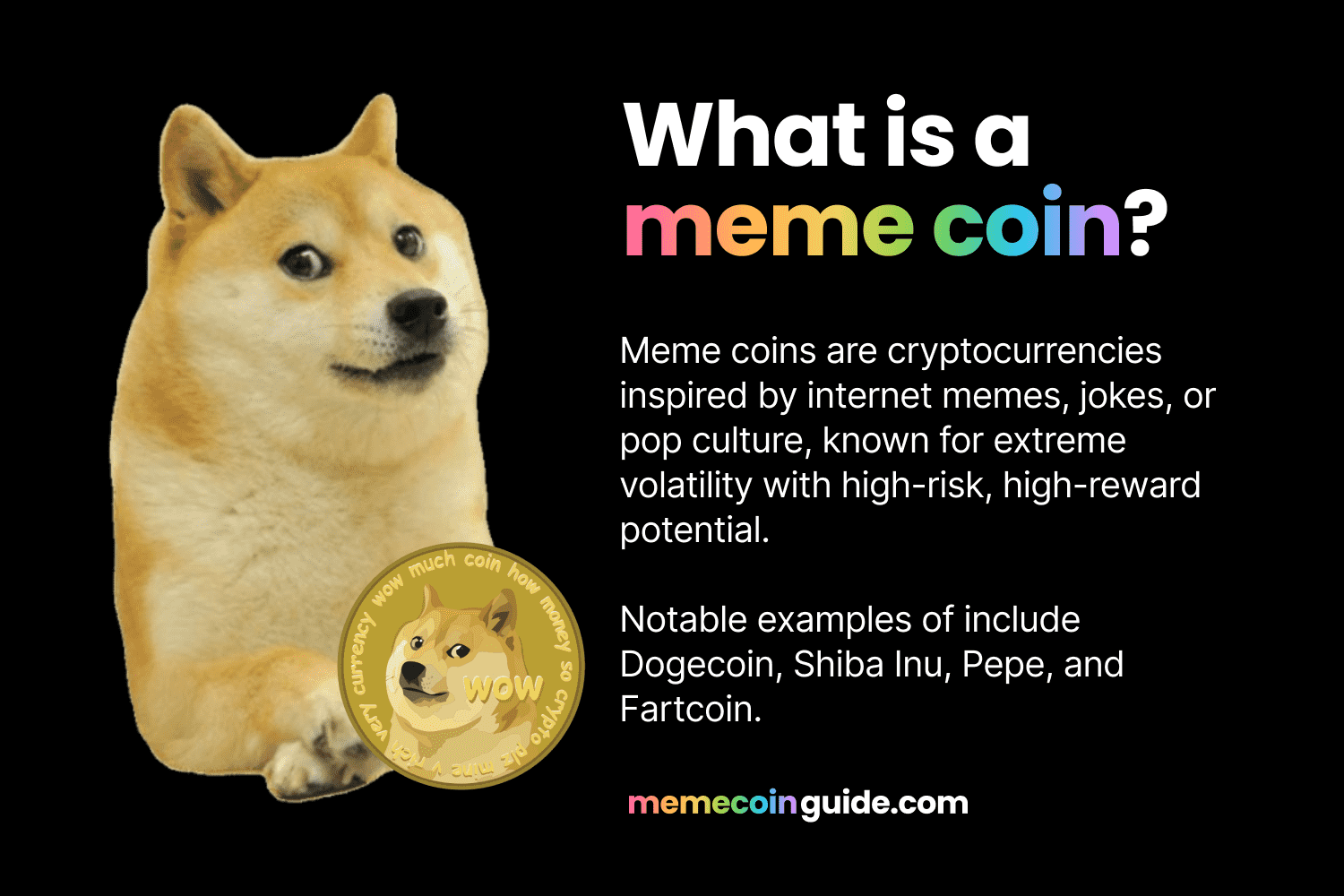
A meme coin is a cryptocurrency built around a joke, a character, or a cultural moment — dogs, frogs, cartoon presidents, whatever's trending.
Unlike Bitcoin or Ethereum, a meme coin typically doesn't do anything. There's no fee revenue, no protocol, no cash flow. The price is driven by community, social posts, and speculation. Treat it accordingly: only put in money you can lose.
Rules vary by country, and regulators pay attention to how a token is marketed and sold. Check local guidance before you buy, and don't assume a playful branding shields the project from enforcement.
Dogecoin (DOGE), Shiba Inu (SHIB), and Pepe (PEPE) are the usual examples. Each started as a meme and ended up with a multi-billion-dollar market cap — but for every one of them, thousands of other tokens launched the same week and went to zero.
How Meme Coins Work
A meme coin starts with a joke, a character, or a moment — a dog, a frog, a politician, a viral animal. Someone mints a token on an existing chain: Ethereum (SHIB, PEPE, MOG), Solana (BONK, WIF, POPCAT), Base (BRETT, TOSHI), BNB, or occasionally a native chain like Dogecoin.
After launch, the creator often disappears. The community takes over on X, Telegram, and Discord. A few projects — Pudgy Penguins with PENGU, for example — hold the underlying IP and keep building. Most don't. Pepe has no tie to Matt Furie. WIF has no roadmap. What they have is people making memes, posting constantly, and pulling in new holders.
You buy them the same way you buy any token. For the majors (DOGE, SHIB, PEPE, BONK, WIF), a CEX like Coinbase, Binance, or Kraken works. For anything newer or smaller, you'll be on a DEX — Jupiter or Raydium on Solana, Uniswap on Ethereum or Base, PancakeSwap on BNB.
The default outcome is failure. Most meme coins lose liquidity within days and never come back. A small share make it to major CEX listings and last multiple cycles. That's the shape of the distribution — know it before you buy.
Crypto Basics for Meme Coins
Quick primer. A blockchain is a shared public ledger; every transaction is recorded and verifiable by anyone. Meme coins are just tokens living on that ledger — on Ethereum, Solana, Base, or BNB.
To hold one, you need a wallet. MetaMask or Rabby for anything EVM (Ethereum, Base, BNB). Phantom for Solana. The wallet holds your private key; the key controls the funds. Lose the seed phrase and the coins are gone. No password reset, no support line.
Every transaction pays a gas fee to the network. On Ethereum a simple transfer now costs cents and a token swap a dollar or two — far below the $20-50 the chain was known for before its 2024-25 upgrades — though fees still spike when a launch congests the network. On Solana it's fractions of a cent. Base and BNB sit in between but closer to Solana.
Tokens on different chains don't talk to each other directly. Moving PEPE (Ethereum) to Solana, for example, requires a bridge — and bridges are historically one of the riskiest surfaces in crypto. Where possible, stick to the native chain.
History of Meme Coins
2013: Dogecoin
Billy Markus and Jackson Palmer launched Dogecoin in December 2013 as a parody of the altcoin mania at the time. The logo was the Kabosu Shiba Inu meme. It wasn't supposed to do anything — and that ended up being the point. A real community formed around it, and meme coins as a category were born.
2020-2021: Shiba Inu and the Dogecoin Run
Shiba Inu (SHIB) launched in August 2020, branded as the "Dogecoin killer." In 2021, DOGE ran from under a cent to roughly $0.73 in five months, helped along by repeated Elon Musk tweets and a broad crypto bull market. Meme coins stopped being a niche joke and became a recurring part of every cycle.
2023: Pepe
Pepe (PEPE) launched on Ethereum in April 2023 with no team, no utility, and no roadmap. It did roughly 7,000% in its first month and crossed a $1B market cap. It also set the template for the current wave: anonymous launch, pure meme, contract address passed around on X.
2024: Launchpads and the Solana Wave
Pump.fun launched in early 2024 and turned token creation into a three-click process on Solana. Millions of tokens got minted. Almost all of them went to zero within days, but a handful — BONK, WIF, POPCAT, Fartcoin, and the Trump token in January 2025 — hit billion-dollar market caps.
2025-2026: The Comedown and the Rules
The peak was December 2024, when the category was worth well over $100 billion. It has not been back. Through 2025 the total meme coin market cap fell by roughly three quarters even as launch volume kept climbing. Two things changed around it. Dogecoin got spot ETFs on US exchanges from September 2025, which put a meme coin inside an ordinary brokerage account. And in March 2026 the SEC and CFTC jointly classified meme coins as "digital collectibles," outside federal securities law. That is the era you are buying into: cheaper launches, thinner liquidity behind them, clearer rules, and a short list of names that keep clearing every cycle.
Types of Meme Coins
Meme coins cluster around themes — who or what the meme is. The usual buckets: dogs, cats, frogs, politicians, famous animals, AI-driven memes, stock-market parodies, and brand or pop-culture riffs.
Dog-themed
Dogecoin
SHIB
Floki
Bonk
Dogwifhat
Cat-themed
Popcat
Aura
Keyboard Cat
Toshi
AI Memes
Fartcoin (conceptualized by AI as the perfect memecoin)
Political
Official TRUMP
Culture Memes
Mog
Giga
Troll
Famous Animals
Moo Deng
Pnut
Frog-themed
Fwog
Matt Furie Memes
Pepe
Brett
Brand Memes
Pengu
Rekt
Murad's Picks
Notable Crypto Twitter personality who released his own list of his best bets of memecoins
Stock Meme
SPX6900
Viral Memes
Chill Guy
Core Characteristics of Meme Coins
Meme coins share a few traits that make them different from the rest of crypto. Use these to size up what you're actually buying:
Community-Driven Value
Price is downstream of attention. A live community — people making memes on X, posting in Telegram, showing up in Discord — is the closest thing a meme coin has to a product. The Shiba Inu "Shib Army" is the obvious example: a Discord joke that grew into an ecosystem with its own L2 (Shibarium) and NFT collection.
Extreme Volatility
50%+ daily moves are routine. A single Elon tweet can double DOGE; a single bad headline can halve it. Meme coin charts don't respect support, resistance, or most of what works on blue chips — they respond to whatever the timeline is paying attention to this hour.
Speculative Nature
No revenue. No cash flow. No moat. The SEC's February 2025 staff statement described many meme coins as closer to collectibles than securities — buyers don't expect profits from anyone's "entrepreneurial efforts." That framing tells you everything about the asset class.
Accessible Entry Point
Most meme coins trade at a fraction of a cent, so $100 buys millions of units. That's part of the appeal — holding a huge number of tokens feels different from stacking sats. It's also the bit people get wrong: the unit price is meaningless. Market cap is what matters.
Put together: community as the fundamental, volatility as the baseline, zero intrinsic value, and a low cost of entry. That's the shape of the category. Plan around it.
What Are the Most Popular Meme Coins?
A short list of the meme coins worth knowing. Dogecoin and Shiba Inu sit in the top tier by market cap and liquidity; the rest come and go with the cycle. One name below them is not a coin at all: MemeCore (M) is a Layer 1 blockchain built for meme coins, live since February 2025, and it now ranks third among meme coins by market cap. Rankings shift constantly — treat this as a map, not a recommendation.

1. Dogecoin
| OWN CHAINA fun, community-driven coin inspired by the "Doge" Shiba Inu meme, launched in 2013.

2. Shiba Inu
| ETHEREUMKnown as the "Dogecoin killer," it's an Ethereum-based coin with a huge community and DeFi ecosystem.

3. Pepe
| ETHEREUMPepe is an Ethereum-based meme coin inspired by the iconic Pepe the Frog internet meme.

4. Bonk
| SOLANABonk is a Solana-based meme coin featuring a playful dog theme, designed to energize the Solana community with its airdropped origins.

5. Official TRUMP
| SOLANAOfficial Trump is a Solana-based meme coin tied to Donald Trump's public persona, launched in 2025.

6. Pudgy Penguins
| SOLANAPudgy Penguins is a Solana-based meme coin rooted in the beloved Pudgy Penguins NFT and consumer brand.
7. SPX6900
| ETHEREUM & SOLANASPX6900 is an Ethereum and Solana-based meme coin that satirically aims to "flip" the stock market with its cult-like community.

8. Fartcoin
| SOLANAFartcoin is a Solana-based meme coin ideated by the Terminal of Truth AI as the "perfect memecoin," and the token that made the 2024-25 AI-meme wave a running joke in traditional finance.

9. dogwifhat
| SOLANAdogwifhat is a Solana-based meme coin featuring a Shiba Inu dog in a pink beanie.

10. Floki Inu
| ETHEREUMFloki is an Ethereum-based meme coin inspired by Elon Musk's Shiba Inu dog and Norse mythology.
11. Mog
| ETHEREUMMog is an Ethereum-based meme coin embodying "tokenized winning" through the joy cat emoji, pit viper sunglasses and "mogging" (domination).

12. Brett
| BASEBrett is a Base-based meme coin inspired by the laid-back character from Matt Furie's Boy's Club comic: Pepe's best friend.
How to Buy Meme Coins
Ready to jump into meme coins? Here's a concise guide to buying them safely and smartly.
1. Choose a meme coin
Choose a meme coin that interests you (e.g., Dogecoin, Pepe, Bonk). Research the project, check its community, and review basic metrics on our coin pages.
2. Identify the blockchain the meme coin lives on
Find out which blockchain the meme coin is on — most are on Ethereum or Solana, but some live on Base, BNB Chain, or other networks. This determines which wallet and exchange you'll need.
3. Decide where you want to buy - a CEX or a DEX
CEX (Centralized Exchange): Easier for beginners, offers fiat on-ramps, requires KYC verification. Examples: Coinbase, Binance, Kraken.
DEX (Decentralized Exchange): You control your funds, no KYC needed, but requires more setup. Examples: Uniswap (Ethereum), Jupiter (Solana).
4. If using a CEX
- Sign up for the exchange where the meme coin is listed
- Complete account verification (KYC)
- Fund your account with fiat or crypto
- Buy the meme coin directly on the exchange
5. If using a DEX
- Set up a wallet on the chain where the meme coin exists (e.g., MetaMask for Ethereum, Phantom for Solana)
- Fund it with the base currency (ETH for Ethereum, SOL for Solana)
- Connect to a DEX like Uniswap or Jupiter
- Swap the base currency for the meme coin
Where to Buy Meme Coins
Looking for the best place to buy meme coins? Your choices fall into three main buckets: launchpads, centralized exchanges (CEXs), and decentralized exchanges (DEXs). Pick based on your experience, custody preference, and coin availability.
Launchpads (Earliest Access)
Ideal for new token launches and pre-listing trades.
Solana: letsBONK.fun, Jupiter Studio
Multi-chain: Pump.fun
Why use them: Early access, low fees (creating a token on Solana costs well under 0.05 SOL all-in), fast listings.
Know before you buy: High risk; verify the official contract address and check liquidity/lock status.
Centralized Exchanges (CEXs) — Easiest for Beginners
Best for popular meme coins already listed.
Examples: Coinbase, Binance, Kraken
Pros: Simple onboarding, fiat on-ramps (card/Apple Pay), high liquidity.
Cons: Requires KYC; exchange holds your funds unless you withdraw.
Typical use: Buy DOGE, SHIB, and other top meme coins, then transfer to your wallet for self-custody.
Decentralized Exchanges (DEXs) — Self-Custody and Variety
Trade directly from your wallet with more control.
Ethereum DEX: Uniswap (requires ETH for gas) + MetaMask
Solana DEX: Raydium/Jupiter (requires SOL for fees) + Phantom
Pros: Privacy, self-custody, access to long-tail tokens (e.g., Popcat).
Cons: You must manage wallets, gas/fees, slippage, and contract verification.
Why Meme Coins Matter
Meme coins sit at the intersection of crypto and internet culture. They take a viral moment — the Kabosu Shiba Inu, Matt Furie's Pepe, a pygmy hippo named Moo Deng, a squirrel named Peanut — and turn it into a liquid, tradable token the same week.
Most of these have nothing to do with the original creator. Matt Furie isn't behind Pepe the coin. The Thai zoo didn't launch Moo Deng. The token is a community artifact, not an official product. That's the unusual part: real money flowing into assets whose entire thesis is "the internet thinks this is funny right now."
For better or worse, that's become a real slice of the crypto market. It's also the entry point for a huge number of new users — people who'd never touch Bitcoin will buy DOGE because it has a dog on it. That's not nothing.
Risks of Meme Coins
Meme coins can be exciting, but they carry real risks that you should understand before you buy. Prices are driven largely by community sentiment and internet culture, which means value can rise or fall very quickly. Use this overview to make informed decisions and protect your capital.
Volatility
Meme coins are the rollercoaster of crypto. Prices can surge by multiples in a single day after a viral tweet or video, then collapse just as fast when attention fades. If you prefer steady returns, this level of hourly and daily price movement may not fit your risk profile.
Limited fundamentals
Many meme coins have little or no underlying utility. Value often depends on narrative, social media visibility, and community belief rather than usage or cash flows. When the community moves on to the next trend, demand can evaporate.
Liquidity and concentration risk
Thin liquidity can make it hard to exit during a sell-off. Holdings may be concentrated in a few wallets or team addresses, which increases the chance that a single seller can move the market.
Scams and impersonation
Hype attracts bad actors. Common tactics include fake token contracts, look-alike websites, and social accounts that impersonate projects or influencers. Never share private keys. Verify the contract address from official channels and avoid clicking unknown links.
Smart-contract and rug-pull risk
Unaudited or malicious contracts can include trading restrictions or functions that let insiders drain liquidity. Check whether liquidity is locked, review top holders, and look for independent code reviews where available.
Platform and regulatory risk
Listings can be added or removed without notice. Access to certain tokens may change by region, payment method, or policy updates. Compliance reviews, KYC requirements, and tax rules can affect your ability to deposit, trade, or withdraw.
Behavioral risk
Fear of missing out and herd behavior can lead to poor timing and overexposure. Set position limits, plan exits, and avoid investing money you cannot afford to lose.
How to reduce risk
Verify the contract address, start with small test transactions, use reputable exchanges or well-known DEXs, enable two-factor authentication, store long-term holdings in secure wallets, and track all-in costs including network fees and spreads. Do your own research and seek multiple independent sources before you buy.
Legal Landscape of Meme Coins
Legal treatment of meme coins varies by country, so check your local rules before buying or creating one.
In the United States, the SEC issued a staff statement in February 2025 indicating that many meme coins — those marketed purely as collectibles, with no promise of profits from managerial efforts — likely fall outside federal securities law. The statement applies the Howey test and compares meme coins to collectibles rather than investment contracts. That's a staff view, not a rule, and it doesn't shield anything labeled "meme coin" from enforcement if the real structure looks like a security. Fraud, manipulation, and pump-and-dump schemes remain actionable under federal and state law, and the CFTC can still act on the commodities side.
In March 2026 the SEC and CFTC went further, issuing joint interpretive guidance that sorts crypto assets into five categories and places meme coins in "digital collectibles" — assets whose value comes from supply and demand rather than anyone's managerial efforts, and which carry no rights in a business. That is the clearest federal statement yet that a plain meme coin is not a security. It changes nothing about fraud, which stays actionable however a token is labelled.
In the EU, MiCA came into force in 2024 and applies to crypto-asset service providers and issuers; most existing meme coins sit outside its scope as non-utility crypto-assets, but marketing rules and MiCA's consumer protection obligations can still bite depending on how a project is run.
How to Create a Meme Coin
Want to launch your own meme coin? It's easier than ever with user-friendly launchpads, especially on Solana. Here's a step-by-step guide to get you started:
1. Pick your meme coin concept
Choose a viral idea, trending meme, or funny concept that people will instantly recognize and want to share. Give your coin a catchy name and ticker symbol.
2. Select your blockchain
Decide which blockchain to use. Solana is popular for low fees and speed, Ethereum for established infrastructure, Base for easy access, and BNB Chain for lower costs.
3. Choose your launchpad
Pick a launchpad based on your blockchain. Popular options include Pump.fun, letsBONK.fun, and Jupiter Studio. These platforms let you create tokens with no coding required.
4. Set up a wallet
Connect a compatible wallet—Phantom or Solflare for Solana, MetaMask for Ethereum or BNB Chain. Fund it with the native token (SOL, ETH, or BNB) for fees and initial liquidity.
5. Create your token
Enter your coin's name, ticker, logo, and description on the launchpad. Add initial liquidity to enable trading. The process typically takes just a few minutes.
6. Grow your community
Build hype on X (Twitter), Reddit, and Discord. Share memes, engage with your community, run contests, and be transparent to build trust and avoid scam accusations.
Future of Meme Coins
Predicting meme coin winners is close to impossible — if it were easy, everyone would be rich. What you can say about the category: launches are faster and cheaper than ever, which means more noise; distribution still runs mostly through launchpads, though those have spread off Solana onto Ethereum, Base and BNB Chain; and the mainstream ceiling has moved past exchange listings entirely — Dogecoin now trades as a US spot ETF, so you can hold a meme coin without ever opening a crypto exchange account.
The floor of the distribution hasn't moved. The overwhelming majority of new meme coins lose liquidity within weeks and never recover — not because of a single rug, but because attention moves on. A handful each cycle survive and become the next DOGE, SHIB, PEPE, BONK, or WIF. You don't know which ones in advance.
Size positions like lottery tickets. This is not financial advice.


